
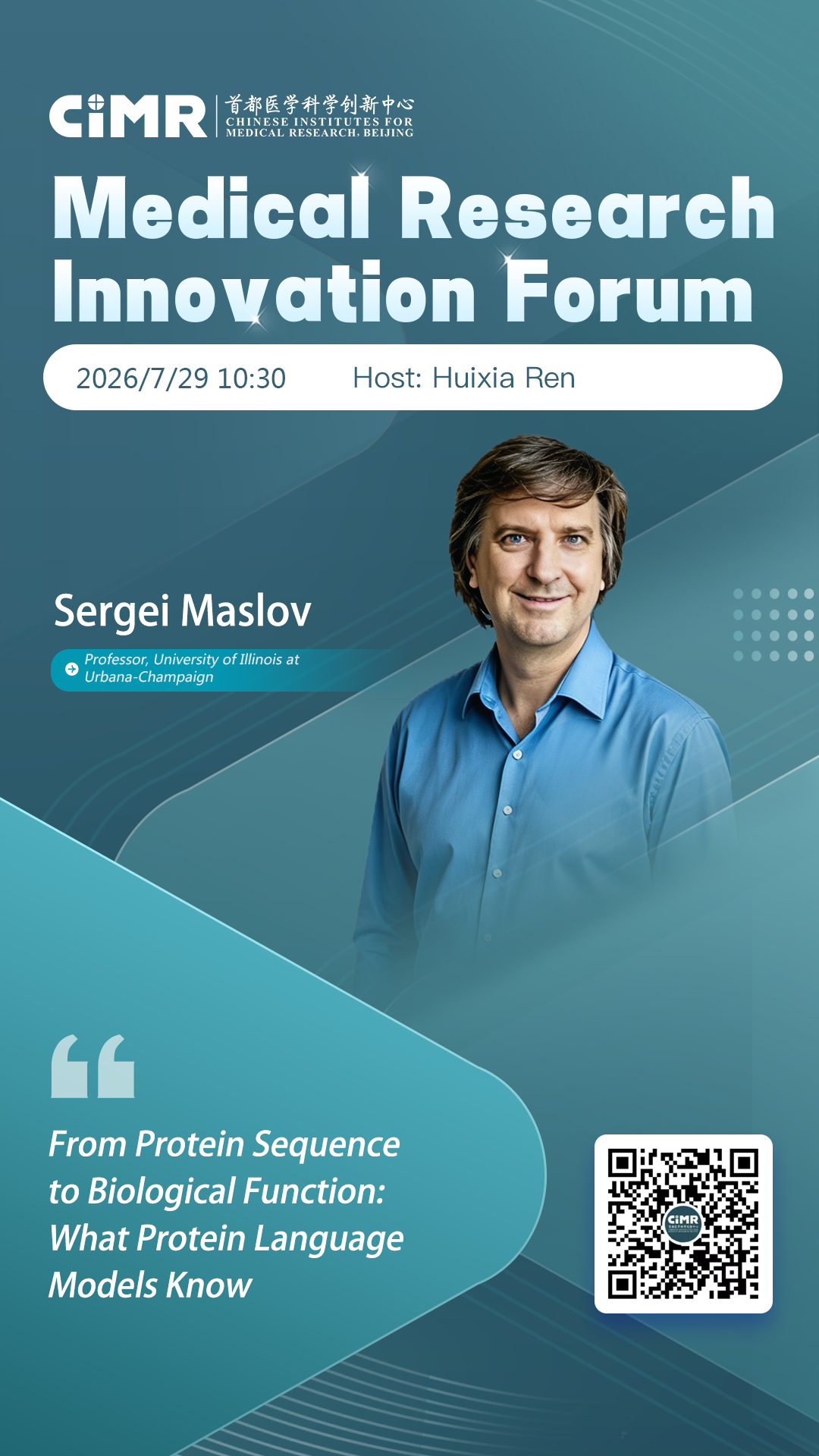
医学创新论坛第99期
时间:2026年7月29日(周三)上午10:30
地点:首都医科大学科研北楼二层科创会堂
主持人:
任会霞
首都医学科学创新中心
报告人:
Sergei Maslov
Professor
University of Illinois at Urbana-Champaign
报告题目:
From Protein Sequence to Biological Function: What Protein Language Models Know
摘要:
I will present how protein language models (PLMs) learn useful representations from large, unlabeled collections of amino-acid sequences, providing a general framework for predicting protein properties without task-specific biological features. I will trace our efforts in developing transformer-based protein modeling, from protein-family classification and prediction of protein-protein interactions to prediction of disordered regions, to current efforts to determine what PLMs know about protein fitness and epistasis.
I will show how contextual sequence representations enable accurate annotation of intrinsically disordered regions through DR-BERT, a compact model trained without explicit evolutionary or biophysical inputs. I will then focus on recent work that interrogates PLM representations to learn the fitness effects of mutations. I will demonstrate that zero-shot PLM scores correlate with epistatic patterns in experimental deep mutational-scanning data: raw scores primarily reflect local structural contacts, whereas nonlinear calibration to the experimental fitness scale exposes long-range couplings enriched in functional protein regions.
Together, these studies frame PLMs not only as flexible predictors, but also as tools for asking how sequence statistics encode protein structure, disorder, function, and evolutionary constraints.
代表性论文:
1. Nambiar A, Heflin M, Liu S, Maslov S, Hopkins M, Ritz A. Transforming the Language of Life: Transformer Neural Networks for Protein Prediction Tasks. BCB '20, 2020.
3. Nambiar A, Littlefield SB, Cuellar C, Khorana R, Maslov S. Protein Language Models Capture Structural and Functional Epistasis in a Zero-Shot Setting. bioRxiv (2025).


 北京市丰台区右安门外西头条10号
 010-86738999
 cimr@cimrbj.ac.cn


 En
En

